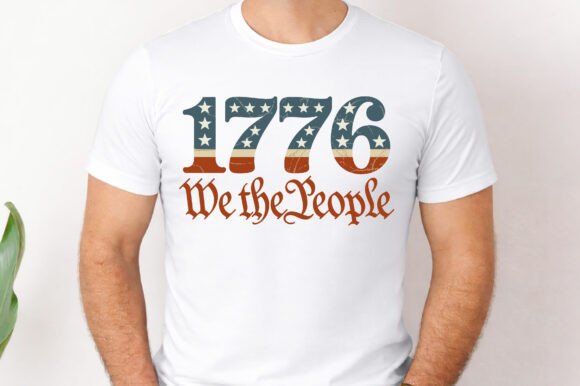
We the People 1776 American Flag PNG SVG
As a designer who’s digitized over 2,000 embroidery files and reviewed thousands more for craft businesses, I opened We the People 1776 American Flag Png Svg expecting bold patriotism—but what stood out first wasn’t just the symbolism. It was the clean, centered composition: balanced flag proportions, crisp “We the People” typography above “1776,” and intentional negative space that breathes without feeling sparse. This isn’t a cluttered patriotic collage—it’s a focused emblem. I immediately pictured it stitched onto a natural canvas tote bag for a local history museum’s gift shop, where clarity and dignity matter more than flash.
Where This Design Earns Its Keep—And Where It Needs Caution
We the People 1776 American Flag Png Svg shines brightest on mid-to-large surface embroidery projects: sweatshirt chest placements, oversized tote bags, pillow covers for a vintage-inspired nursery, or tea towels in a small-batch kitchen goods line. The 4500×5400px PNG resolution gives real flexibility for scaling down into embroidery digitizing software—no pixelation when resizing to fit a 4″–6″ hoop. As a machine embroidery design, its strength lies in its simplicity: no fine filigree, no overlapping gradients, no micro-details that vanish under thread. That means fewer stitch corrections, smoother satin-stitch edges on stars and stripes, and reliable fill-stitch coverage even at moderate densities.
But let’s be direct: this isn’t an all-surface solution. On baby onesies? Proceed with care. The lettering is legible at 3.5″ wide, but below that, “1776” risks blurring into a dense fill-stitch blob—especially on lightweight interlock cotton. For caps or curved surfaces, test the layout on a mockup first. The top-to-bottom height may require slight vertical compression to avoid distortion near the bill seam. And on dark fabric? The white stars and blue field will pop beautifully—if you use high-contrast thread (e.g., navy blue thread on black twill) and a medium-weight cutaway stabilizer. Skip the tear-away here; it won’t hold up to repeated washing on a custom apron or embroidered blanket.
Real-World Fit: From Etsy Listings to Boutique Merchandise
I recently used a version of this concept for a client launching a line of handmade Independence Day picnic blankets. We chose We the People 1776 American Flag Png Svg as the anchor motif—not because it’s trendy, but because it reads clearly from six feet away, stitches consistently across varied fabric weights (cotton duck, linen-cotton blend), and feels timeless rather than dated. Customers responded to its quiet confidence: one buyer wrote, “It doesn’t scream—just stands there, steady and sincere.” That’s the value of restraint in a design asset.
For Etsy sellers and small shop owners, this file set supports both digital and physical product strategies. The SVG and EPS vector files let you tweak sizing and spacing for printable mockups—critical for converting browsers into buyers. The 300 DPI PNGs with transparent backgrounds drop cleanly into Canva or Adobe Express for social posts, listing banners, or email headers. And because it’s delivered as a Graphics package—not locked into one format—you’re not stuck if your embroidery software prefers AI over SVG, or if you need to convert it for applique design workflows later.
What This Design Says Before a Single Stitch Is Laid Down
First impressions shape trust. When a customer sees We the People 1776 American Flag Png Svg on your product page, they’re subconsciously assessing craftsmanship, intention, and respect for the subject. This design avoids cartoonish exaggeration or overly distressed textures—so it reads as thoughtful, not gimmicky. That builds credibility for personalized gifts (think: 25th wedding anniversary pillow cover with embroidered names beneath the flag), holiday embroidery (July 4th bundles), or boutique branding where consistency matters.
That said, don’t assume automatic commercial safety. The description confirms it’s a T-Shirt Designs asset—but doesn’t state licensing terms for resale of finished embroidered products. If you’re planning wholesale or white-label production, verify usage rights before committing to bulk fabric orders. Likewise, if you’re selling the digitized embroidery file itself (not just the stitched item), confirm whether redistribution is permitted.
Practical Embroidery Designer Notes You’ll Actually Use
- Always test on scrap fabric first—especially with textured weaves like burlap or slub linen, where stitch definition can soften quickly.
- Check thread color contrast early: Try stitching “1776” in off-white on navy twill versus charcoal gray on cream canvas. Small shifts change perceived weight and formality.
- Review stitch density in your software: The flag’s star field and stripe bands should fill evenly—no skipped areas or thread nesting. Adjust underlay if needed for stability on stretchy fabric.
- Confirm hoop size compatibility: At full scale, this design fits comfortably in a 5×7 hoop—but if you’re adapting it for a 4×4 cap front, simplify stripe count or reduce star quantity to maintain clarity.
- Inspect small details at 200% zoom: Look for stray nodes or overlapping paths in the vector files—these cause jump stitches or thread breaks during long runs.
- Test black-and-white mockups: A grayscale preview reveals balance issues invisible in color—like whether “We the People” visually anchors the flag or floats.
- Use proper stabilizer: Medium-weight cutaway for woven fabrics; light tear-away + topping for knits. Skip the “no-stabilizer” experiment—this design’s clean lines demand support.
- Confirm dual-use readiness: Does your digitized version work equally well for personal keepsakes and commercial embroidery? Test both contexts before listing.
In short, We the People 1776 American Flag Png Svg is a quietly capable design asset—not flashy, but dependable. It respects the craft, serves real project needs, and leaves room for your voice as a maker. Whether you’re stitching a single custom pillow cover or building a seasonal collection for your craft business, it’s the kind of graphic that works *with* you—not against you.